Agent skills · Claude Code · Codex · Python stdlib · MIT
Your coding agent, working as a game analyst
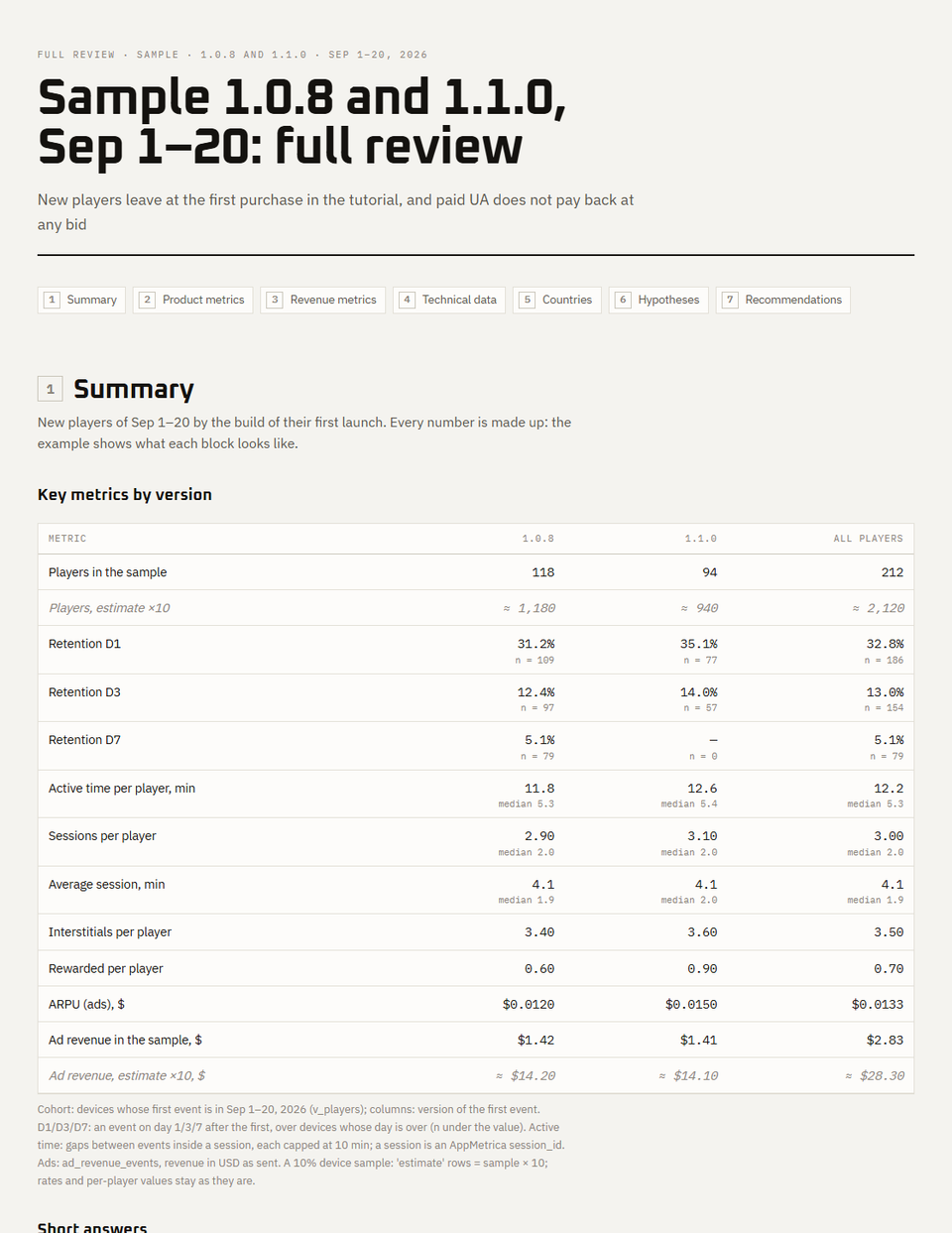
Install the kit into a game project and ask in plain words. The agent pulls the raw AppMetrica events into a local SQLite database, learns what this game's events mean, checks its own numbers and publishes a report you can forward to anyone — the same seven blocks every time.
Open a live example report Star on GitHub
How it works
- Install
py install.py <project>copies seven skills for Claude Code and Codex and a small engine into the game repository. Nothing topip install. - Connect“Connect AppMetrica.” The agent finds the SDK key in the code, uses your read-only token and pulls the data in the background — sampling devices when the game is big.
- Model“Build the data model.” It reads the catalog of events and the game's analytics code, types the parameters, filters developer devices, defines sessions and new players.
- Ask“Make a full review of the last two weeks.” “Where do new players leave?” “Did 1.2 help?” Every answer is a versioned report, and the findings stay in the project for the next session.
One structure for every report
A reader and the next agent find the same thing in the same place. The builder refuses a report whose structure or links are broken.
Summary
Key metrics with build versions as columns — D1/D3/D7, playtime, sessions, ads per player, ARPU, revenue — and short answers to what you asked.
Product
Retention, drop-off by loading and tutorial steps and by every 30 s of play, core actions by their number in the session, leaving after negative events, economy.
Revenue
Ads by format, placement and network; eCPM; purchases.
Technical
Technical problems and analytics defects: duplicates, empty fields, sources that disagree — and which metric each one biases.
Countries
The country split in one place.
Hypotheses
H1, H2… each resting on linked numbers, with a test and a threshold, and a confidence.
Recommendations
Each linked to a hypothesis, with the expected effect and how to measure it.
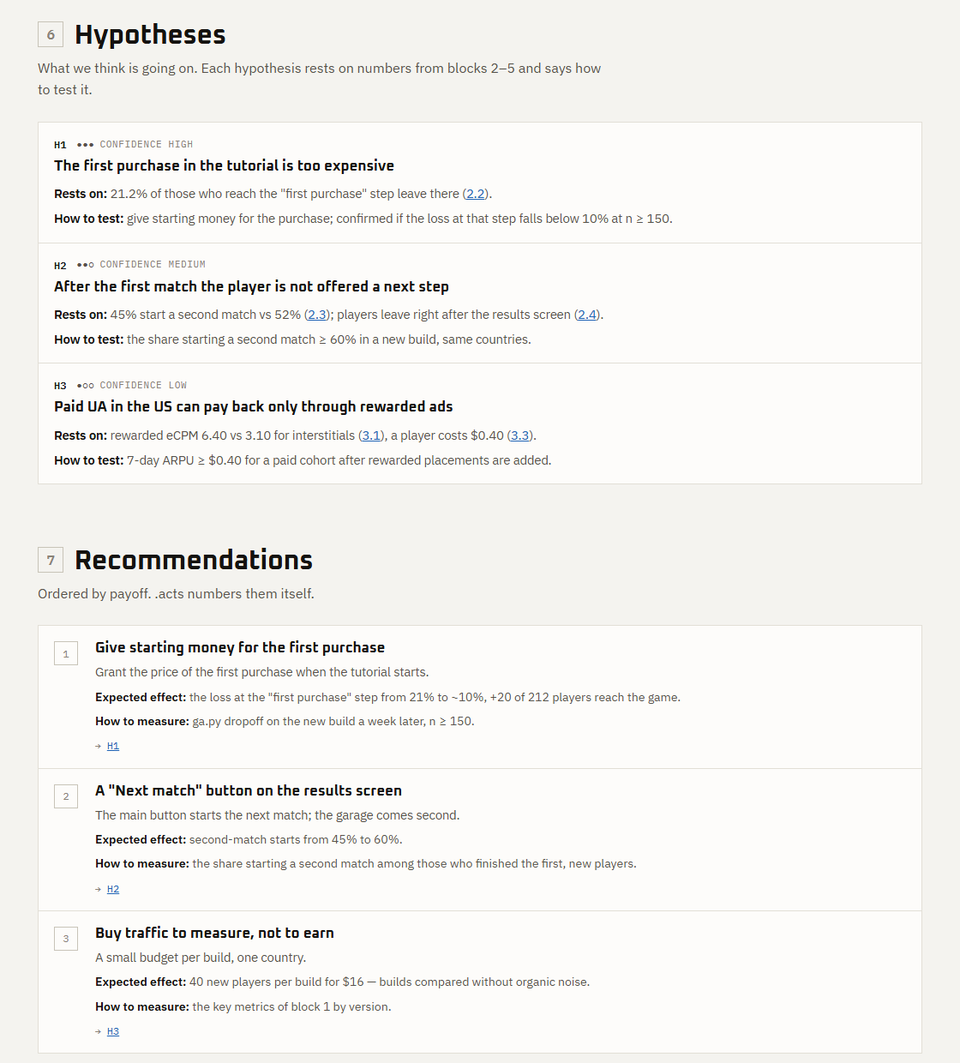
Live examples on made-up numbers: full review · question report · report index with versions
What's inside
Seven skills
analytics-kit— entry point and command sheetanalytics-connect-appmetrica— key, token, first pullanalytics-data-model— typed events, devices, sessionsanalytics-project-audit— what the code tracks vs what arrivesanalytics-import-external— Google Ads, AdMob, GA4, Play Console exportsanalytics-research— question → data → hypotheses → independent checkanalytics-report— the fixed structure, charts, versions
An engine you can read
- Python standard library only, Windows first class
- AppMetrica Logs API by date ranges, detached background pulls
- Device sampling and a disk guard for games with 500k+ events a day
- Standard tables: key metrics, drop-off, ordinals, leaving
- Self-contained HTML reports, light and dark, readable on a phone
- Offline selftest on synthetic data; tested end to end with real agents
Quick start
Python 3.11+, git, Claude Code or Codex, and a game that already sends events to AppMetrica.
git clone https://github.com/Trafalgardi/game-analytics-kit.git <kit>
py <kit>/install.py <project>           # python3 on macOS/Linux

# a read-only AppMetrica token, once for all projects:
#   ~/.config/game-analytics-kit/.env  →  APPMETRICA_TOKEN=...

cd <project> && claude                   # or: codex
> Connect AppMetrica and pull the last two weeks.
> Build the data model.
> Make a full review of the game for the last two weeks.
The full guide — token steps, big games, updating, security, troubleshooting — is in the README.